














Oklahoma Trucking Wreck Attorneys
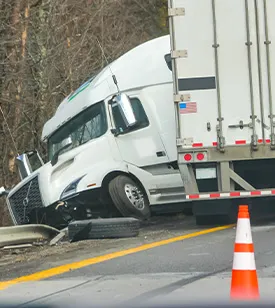
When 80,000 pounds of steel meets a family car.
Oklahoma highways carry more risk than most drivers realize — and so should the companies behind the trucks. From the moment a serious truck crash happens, the carrier’s insurance team is already working. Your family deserves the same urgency on your side.
Trucking cases are not ordinary auto cases.
A collision with a fully loaded semi is not the same as a collision between two passenger cars. The forces are different. The injuries are worse. The defendants are larger and better-resourced. And from the moment a serious truck crash happens, the trucking company’s insurance carrier, defense counsel, and incident reconstructionists are already working — often on the scene within hours.
Your family deserves the same urgency on your side. Trucking cases involve federal regulations, multiple potentially liable companies, and evidence that begins disappearing the moment the wreckage is cleared. The right legal team knows where to look, what to demand, and how to move before the trail goes cold.
Most serious trucking wrecks are not accidents — they are the predictable result of choices made long before the collision. Schedules, hires, maintenance, training. Federal data and our own case experience point to the same set of root causes again and again.
The predictable result of choices made long before the collision.
Federal data and our own case experience point to the same set of root causes again and again. Most are preventable. Most involve decisions made by drivers, dispatchers, and carriers under pressure to deliver more freight in less time.
Driver Fatigue & Hours-of-Service Violations
Federal rules limit how long a driver can be behind the wheel. Carriers that push schedules — or drivers who falsify their logs — create the conditions for catastrophic crashes.
Distracted Driving
Texting, dispatch communications, navigation, and onboard systems take eyes off the road. The FMCSA prohibits hand-held cellphone use by commercial drivers — but those rules are routinely ignored, and it costs lives.
Speeding & Aggressive Driving
An 80,000-pound truck cannot stop, swerve, or recover the way a car can. Speeding and tailgating in a commercial vehicle are not minor violations — they are the leading cause of fatal truck crashes.
Impaired Driving
Drugs, alcohol, and prescription medications behind the wheel of a commercial vehicle expose not just the driver but the carrier, the carrier’s testing program, and sometimes the dispatcher.
Inadequate Driver Training
A CDL is a minimum, not a guarantee. Carriers that hire underqualified drivers, skip training, or ignore prior violations can be held directly liable for negligent hiring and supervision.
Brake & Mechanical Failures
Brake failures, tire blowouts, and steering defects often trace back to skipped inspections or deferred maintenance. Maintenance records — when they exist — tell the story.
Improper Loading & Cargo Shifts
Overweight loads, unbalanced trailers, and unsecured cargo cause rollovers, jackknifes, and loss of control. Liability often extends to the shipper or the loading facility.
Adverse Weather & Road Conditions
Ice, fog, rain, and high winds across Oklahoma’s interstates demand reduced speeds and increased following distance. A “weather” crash is rarely just a weather crash.
Critical evidence — electronic logging device (ELD) data, dashcam footage, driver logs, maintenance records, dispatch communications — can be overwritten or lost within days. Acting quickly is not optional in trucking cases.
The driver is rarely the only defendant — and often not the most important one.
One of the most important differences between a truck case and an ordinary car collision is the number of potentially responsible parties. Identifying every defendant — and every applicable insurance policy — is often what separates an adequate recovery from a meaningful one.
The Truck Driver
The most visible defendant — but rarely the deepest pocket. Driver liability is typically the entry point to the carrier’s coverage.
The Trucking Company (Motor Carrier)
Vicariously liable for the driver, and directly liable for negligent hiring, retention, training, supervision, and unsafe scheduling practices.
The Cargo Loader or Shipper
Improperly loaded, overweight, or unsecured cargo frequently causes rollovers and jackknifes. Liability can extend to whoever loaded — and whoever signed off.
Maintenance Contractors
Many carriers outsource maintenance. When a brake job, tire rotation, or DOT inspection was performed negligently, the contractor can share in the responsibility.
The Truck or Parts Manufacturer
Defective tires, brake systems, coupling devices, and electronic control modules give rise to product liability claims that proceed alongside the negligence case.
Brokers & Logistics Companies
Freight brokers who select unsafe carriers — or who ignore poor safety ratings — can face liability for negligent selection under evolving Oklahoma and federal law.
If you or a family member was hurt in a truck crash — the steps that protect your case.
The trucking company’s insurance carrier may contact you within days — sometimes within hours — of the crash. Each step they take is to protect their interests, not yours. These are the steps that protect yours.
Get medical care first.
Seek treatment for every injury, even those that seem minor at first. Documented medical care is both the right thing for your health and the foundation of any later case.
Do not give a recorded statement.
The carrier’s insurer may ask for a recorded statement framed as routine. You are under no obligation to give one. Anything recorded can and will be used to limit what you recover.
Do not sign a medical authorization.
A blanket authorization can quietly grant access to far more of your records than the case requires. Have a lawyer review what is actually being asked for.
Do not accept a quick settlement.
Early offers are framed as goodwill. They are designed to extinguish your claim before the full extent of injuries — or the full picture of liability — is known.
Preserve the evidence.
Do not authorize repairs to your vehicle. Keep clothing, devices, photos, and the names of any witnesses. Black box and ELD data can be lost in routine carrier operations within weeks.
Call before signing anything.
The first conversation costs you nothing. What you do — or don’t do — in the first weeks after a crash can shape everything that follows.
There is a remedy. There is also a clock — and it runs faster than the statute.
Oklahoma’s statute of limitations gives you two years from the date of the crash to file most personal injury claims, and two years from the date of death for wrongful death claims. Cases involving government vehicles or government contractors can require formal notice in as little as 90 days. Beyond the statute, evidence-preservation deadlines are far shorter — black box data, ELD records, and dashcam footage can be lost in routine carrier operations within weeks. If you think you may have a case, the answer is to call, not to wait.
Recoveries that reflect the severity of what these crashes cost families.
Past results do not guarantee future outcomes — every case is decided on its own facts. They do, however, demonstrate what is possible when a family has the right advocate working on their behalf.
We know where to look, what to demand, and how to move before the trail goes cold.
Trucking cases turn on federal records, regulations, and the corporate decisions that preceded the crash. We know where to look and how quickly we have to get there.
-
Immediate evidence preservationELD and ECM data, dashcam and surveillance footage, driver logs, dispatch records — we move fast to issue litigation holds and subpoenas before anything is overwritten.
-
Federal regulation depthWe work with FMCSA hours-of-service rules, driver qualification files, drug-and-alcohol testing programs, and the multi-party corporate structures common in serious trucking cases.
-
Every potentially liable partyDriver, motor carrier, shipper, loader, maintenance contractor, parts manufacturer, broker — we identify every defendant and every applicable insurance policy from day one.
-
No fee unless we recoverWe handle these cases on contingency. The free consultation costs you nothing, and you pay nothing unless we recover compensation for you.

Your instinct to act on this matters. So does timing.
Tell us what happened. We will review the situation, explain your options in plain language, and tell you whether there is a case to pursue. There is no fee to talk to us, and no fee unless we recover for you.
Request a Free Case Review
All consultations are confidential. Response within one business day.